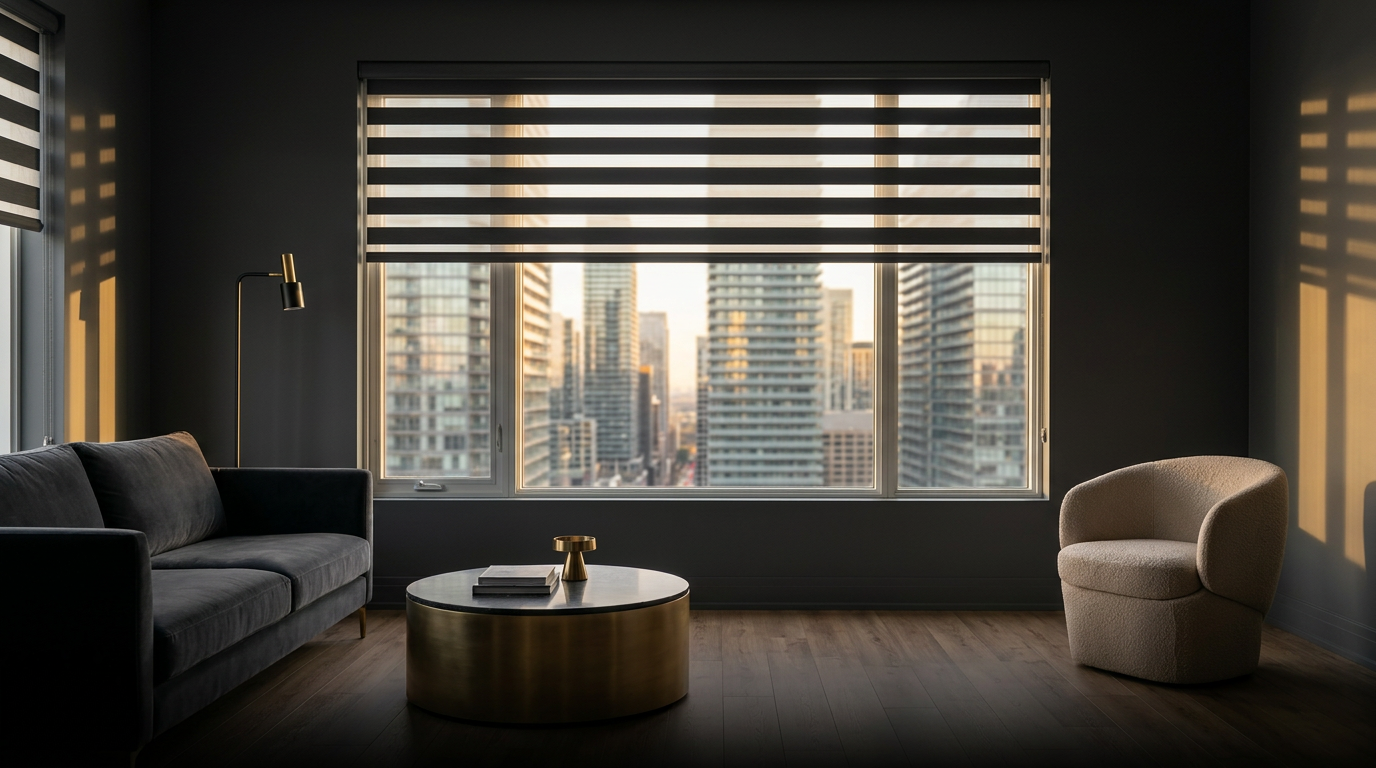
If you have been shopping for window coverings in Ontario and noticed that some retailers call them zebra blinds while others list the exact same product as dual shades, you are not imagining things — they are the same window covering. The confusion comes entirely from inconsistent industry naming, not from any difference in the product itself.
Both terms describe a single-fabric shade made of alternating horizontal bands of sheer and opaque material. By rolling the fabric up or down you shift those bands in or out of alignment, giving you precise control over light and privacy without ever needing two separate window treatments. Below we break down why two names exist, what the product actually does, and what to look for when ordering one for your home.
We bring the full collection to your home, measure every window, and leave you with a written quote the same day — at no cost.
Book a Free In-Home ConsultationSame Product, Two Names
The window covering industry has never agreed on a single universal name for this style of shade. Zebra blinds became the popular consumer term because the alternating light and dark fabric bands look like a zebra's stripes when the shade is partially open. Dual shades is the more formal trade and manufacturer label — it references the two layers of fabric (sheer and solid) that make up the shade's construction.
You may also encounter it listed as vision shades, banded shades, transitional shades, or layered shades depending on the supplier. Every one of these names refers to the same mechanism and the same look. If you walk into any showroom asking for a zebra blind and the consultant pulls out a dual shade sample, they have given you exactly what you asked for.
Quick note for GTA shoppers: In the Greater Toronto Area and across Ontario, "zebra blinds" is by far the most common search term homeowners use. If you are comparing quotes from multiple suppliers, confirm the product name each vendor uses so you are comparing the same item — not accidentally pricing two different styles.
How They Work: The Mechanics
A zebra blind / dual shade is constructed from a single continuous loop of fabric. That fabric alternates between sheer panels — which let in diffused natural light — and solid panels — which block light and provide privacy. The headrail and bottom rail hold the front and back layers of the fabric loop taut.
When you lower the shade, the front and back layers hang one in front of the other. At any point during operation you can stop and adjust the fabric so that:
- Sheers align with sheers — maximum light, minimal privacy (open position)
- Solids align with solids — full privacy and light block (closed position)
- Sheers align with solids — the sweet spot most homeowners use daily, delivering filtered light with a comfortable level of privacy
This range of adjustment is why zebra blinds became so popular in modern Ontario homes — they replace the need for both a sheer curtain and a privacy blind with a single, clean-looking shade.
Why They Became So Popular in Ontario
Zebra blinds took off across the GTA and Southern Ontario for a handful of practical reasons. New construction condos and townhomes in Brampton, Mississauga, and Vaughan often have large windows with minimal architectural privacy, making a product that transitions smoothly between open and private positions extremely useful. The sleek, flat profile also pairs naturally with the modern interiors common in newer builds.
Compared to traditional horizontal blinds, zebra shades are also easier to clean — there are no individual slats to dust — and the fabric construction softens the look of a room in a way that vinyl or aluminum blinds cannot. For west-facing rooms that deal with strong afternoon sun, the ability to dial in partial filtering without completely closing the shade is a genuine quality-of-life improvement.
Motorized Zebra Blinds: What to Know
Motorization is one of the most popular upgrades for zebra blinds, and it works exceptionally well with this style because the precise band alignment that makes them so versatile is much easier to achieve with a motor than by hand. A motorized zebra blind lets you set your preferred light position and return to it every time with the press of a button or a voice command via a smart home system.
If you are ordering zebra blinds for multiple windows — a common scenario in new builds — deciding on motorization at the time of ordering is far simpler and more cost-effective than retrofitting manual shades later. The headrail dimensions differ between motor and non-motor versions, so the decision is best made before your windows are measured.
Motorization tip: For large or floor-to-ceiling windows, a motor also eliminates the risk of uneven rolling that can occur with manual operation on very wide shades. It is worth factoring in from the start if your windows exceed roughly 72 inches in width.
Fabric, Colour & What to Look For
Because zebra blinds are fundamentally a fabric product, the quality of the material matters more than the mechanism. When selecting a shade, pay attention to the opacity percentage of the solid bands — a "light filtering" solid and a "blackout" solid look identical in a showroom sample but will perform very differently in a bedroom at 6 a.m. Ask your supplier to confirm the light-blocking rating of the specific fabric, not just the product line.
Colour and texture choices have expanded significantly in recent years. Beyond the classic neutrals — white, cream, grey, and charcoal — you can find warm linens, soft wovens, and even subtle textured weaves that add depth to a room. For cohesion across an open-plan living space, ordering all windows in the same fabric and colour is worth the upfront planning, since shade fabrics can vary slightly between production runs.
Which Rooms Are They Best For
Zebra blinds work in almost every room, but they perform particularly well in spaces where you want natural light and privacy at the same time — rather than choosing one or the other.
Living Room & Open-Plan Areas
This is where zebra blinds shine. The ability to filter strong afternoon or evening sun while keeping the space bright and connected to the outdoors is their strongest feature. View our zebra blind collection to see how they look across a range of room styles.
Home Office
Glare on a monitor is one of the most common complaints in home offices with south or west-facing windows. The partial-filter position of a zebra blind cuts glare without plunging the room into darkness, which is difficult to achieve with most other window covering types.
Bedroom
For bedrooms where complete darkness is a priority — particularly for young children or shift workers — ensure you select a fabric with a true blackout solid band. A standard light-filtering solid will reduce but not eliminate early morning light. Pair with a drapery panel for maximum darkness if needed.
Kitchen & Bathroom
Zebra blinds are not a moisture-rated product, so they are best suited to dry kitchens rather than directly above a sink or in a bathroom with high humidity. For those spaces, consider a moisture-resistant roller shade instead.